
Your EHR vendor may automate coding and claim submission.
OACIS owns everything that happens next — and stays accountable for the outcome at every step of the revenue lifecycle.
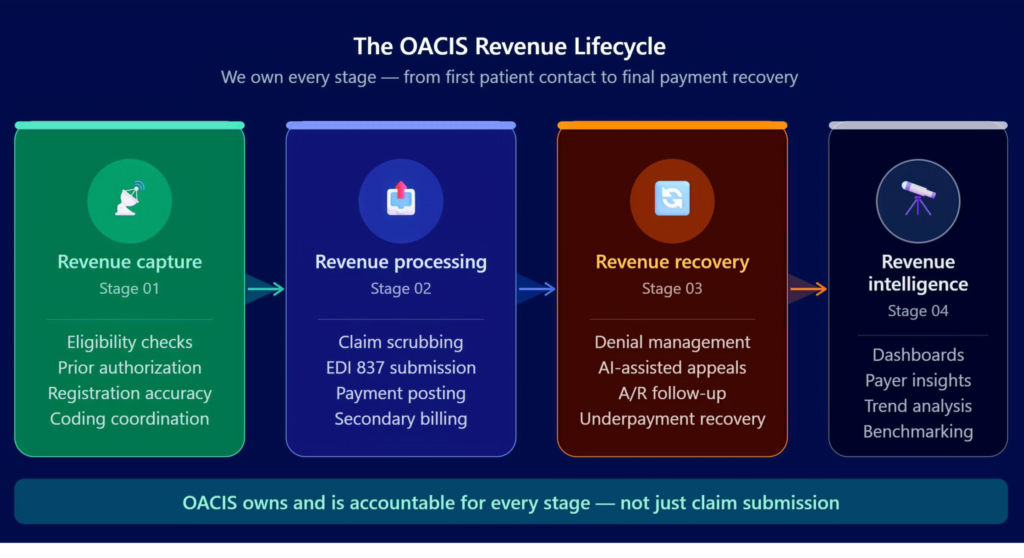
The OACIS revenue lifecycle — we own every stage
Revenue Capture
Coding & accuracy
Revenue Processing
Claims & payments
Revenue Recovery
Denials & A/R
Revenue Intelligence
Insights & ownership
Revenue ownership — not just Revenue processing
Every OACIS client has a dedicated Revenue Operations Manager. Not a ticket number. Not a shared queue. One person who understands your practice, your payer mix, and your revenue goals — and is accountable for the outcome.
Dedicated Manager
A single point of accountability who knows your practice inside and out — not a different person every time you call.
Proactive Alerts
We identify issues before they become problems. You hear about denial trends before they affect monthly collections.
Cross Practice Intelligence
We see payer patterns across all our clients simultaneously. When trends emerge, we act on your behalf before others even notice.
Performance Accountability
Monthly dashboards, quarterly reviews, and transparent metrics. You always know exactly where your revenue stands.
We will never be the largest revenue cycle company. We choose to be the most accountable — limiting our client-to-manager ratios so every practice receives the focus it deserves.
Stage 01
10-20%
Of urgent care practices are systematically undercoding without realizing it
Medical coding is where the clinical encounter becomes a financial claim. Errors at this stage — undercoding, overcoding, mismatched CPT-ICD combinations, missing modifiers — create denials, underpayments, compliance risk, and lost revenue that most practices never recover.
OACIS assigns experienced, specialty-specific coders supported by AI-assisted code validation to ensure every encounter is coded accurately, completely, and in compliance with payer requirements before the claim is generated.
- Specialty-specific ICD-10 and CPT coding
- AI-assisted code suggestion and validation
- Modifier review and application
- CPT-ICD compatibility checks
- Undercoding and overcoding detection
- Documentation gap identification
- Regular coding audits and quality reviews
10-20%
Of urgent care practices are systematically undercoding without realizing it
Revenue impact
- Every encounter billed at the level it was documented
- Fewer denials from CPT-ICD mismatches
- Reduced compliance and audit risk
- Providers informed of documentation patterns
Without this
- Undercoding leaves money permanently on the table
- Modifier errors create avoidable denials
- Overcoding creates audit exposure
Stage 02
98%+
Clean claim rate target — meaning the claim is correct and complete before it ever leaves
A clean claim is one that is complete, correct, and payer-specific before it is ever submitted. OACIS runs every claim through a multi-layer scrubbing process that checks payer-specific rules, bundling edits, modifier requirements, and documentation completeness before transmission.
After payment arrives, our team posts remittances accurately and reconciles every payment against the contracted rate — identifying discrepancies before they become write-offs.
- Multi-layer claim scrubbing before submission
- Payer-specific rule validation
- Electronic claim transmission (EDI 837)
- Clearinghouse management and monitoring
- ERA and EOB payment posting (EDI 835)
- Contractual adjustment reconciliation
- Secondary and tertiary claim billing
98%+
Clean claim rate target — meaning the claim is correct and complete before it ever leaves
Revenue impact
- Faster payments through cleaner first submissions
- Reduced clearinghouse rejections
- Accurate payment posting and reconciliation
- Secondary billing captured automatically
Without this
- Claims return with errors, delaying cash
- Payment posting errors create false A/R
- Secondary billing missed
Stage 03
5-15%
In avoidable revenue is written off annually by practices that don’t actively pursue aged A/R
Denial management is where most of the financial damage occurs in an under-managed revenue cycle. Claims are denied for preventable reasons, sit in queues unworked, or are written off prematurely — and the practice never knows what was lost.
OACIS uses AI-powered denial prediction before submission to flag high-risk claims, and a dedicated recovery team to work all denials, draft appeals, and follow up on aging A/R with escalating urgency as timely filing deadlines approach.
- AI-powered denial risk prediction before submission
- Denial categorization, routing, and prioritization
- AI-assisted appeal letter generation
- Payer escalation and peer-to-peer coordination
- Timely filing monitoring with automated alerts
- A/R aged-bucket follow-up (30, 60, 90, 120+ days)
- Underpayment identification and recovery
5-15%
In avoidable revenue is written off annually by practices that don’t actively pursue aged A/R
Revenue impact
- Fewer denials through pre-submission prediction
- Higher appeal success rates with AI-assisted letters
- Reduced aging A/R through systematic follow-up
- Underpayments flagged and recovered
Without this
- Denials sit unworked past filing deadlines
- Underpayments are never identified
- A/R grows and ages into bad debt
Stage 04
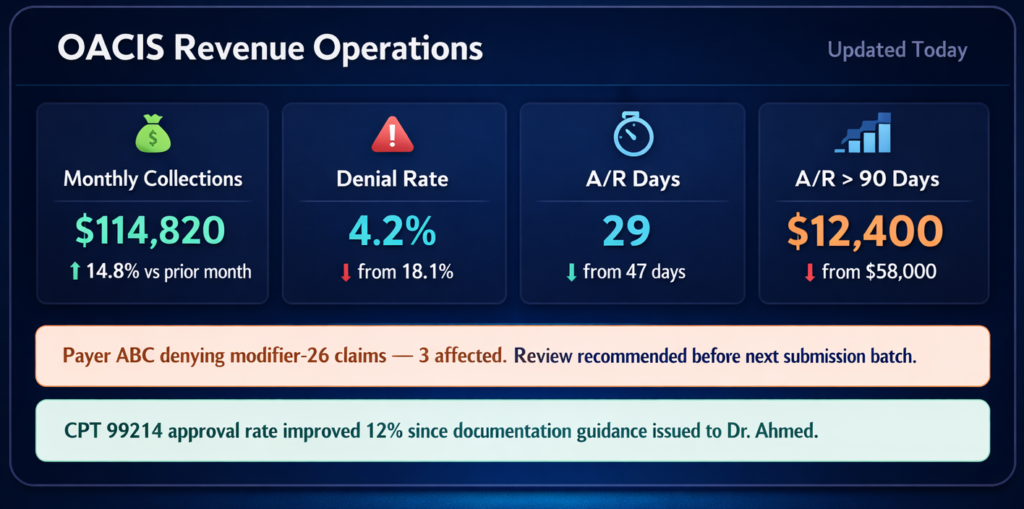
Most practices receive reports that describe what happened. OACIS provides intelligence that identifies what’s about to happen — and what to do about it.
Because OACIS works across multiple practices simultaneously, our revenue intelligence combines your practice’s data with cross-facility payer trend analysis. When a payer starts tightening criteria or changing reimbursement patterns, we see it across all our clients — and can alert your practice before it impacts your cash flow.
- Monthly Revenue Operations Dashboard
- Denial trend analysis and root-cause identification
- Payer performance benchmarking
- Revenue leakage identification and quantification
- Provider-level coding and documentation insights
- Cash flow forecasting
- Quarterly revenue operations review meetings
Most RCM companies stop after claim submission. OACIS doesn't
We track every claim, follow up on every outstanding balance, and identify every underpayment — because we're accountable for the financial outcome, not just the transaction.
A Revenue Operations Review audits your full billing cycle and produces a Revenue Snapshot showing collections, leakage, and the realistic improvement opportunity.
More from OACIS
Revenue operations review
A free 30-minute assessment of your current revenue performance, leakage points, and improvement opportunity.
Revenue operations insights
Articles, research, and analysis on how AI and payer changes are reshaping revenue operations for independent practices.
Patterns we see again and again across independent practice revenue cycles.
The OACIS Healthcare team demonstrated a strong understanding of urgent care revenue cycle complexity and brought a level of operational insight that went far beyond traditional billing discussions. Their structured audit identified several revenue leakage patterns and meaningful operational and financial optimization opportunities that were not previously visible to our team.
We frequently begin audits at practices running denial rates near 20%, with no payer-specific workflow behind their billing. The denials are overwhelmingly preventable — eligibility gaps, missing authorizations, and modifier errors — and a disciplined, payer-specific process is what separates a sub-5% denial rate from a 20% one.
Claim rejections in the low double digits are common in practices without a structured front-end review. In our experience, the issue is almost never coding talent — it's the absence of a consistent guideline system. Once one is in place, rejections and denials typically fall sharply within the first two months.
A recurring red flag we document is A/R over 90 days sitting well above benchmark — often a quarter or more of total receivables — while net collection rates quietly underperform. Aging A/R is the clearest early signal that follow-up has no owner, and it's usually the fastest place to recover real dollars.
Out-of-network and non-par claims are where we see the most revenue left on the table. Without a deliberate strategy for timely filing and payer negotiation, low reimbursements get accepted as final and written-off balances go unrecovered — when many are, in fact, collectible with the right approach.