
Most reimbursement problems originate at the front desk — not in the billing department. Incorrect demographics, inactive insurance, missing authorizations, and registration errors create downstream denials that are entirely preventable.
Where OACIS intervenes in the patient journey
Scheduling
Help desk support
Eligibility
48h before visit
Authorization
Submit & track
Registration
Clean demographics
Visit
Provider sees patient
Claim
See billing page
Where OACIS intervenes in the patient journey
Scheduling
Help desk support
Eligibility
48h before visit
Authorization
Submit & track
Registration
Clean demographics
Visit
Provider sees patient
Claim
See billing page
Industry insight: Nearly half of all claim denials originate from eligibility and prior authorization failures — issues that are entirely preventable with the right front-office workflows in place before the patient is seen
Service 01
30%
Of provider time lost to no-shows and scheduling gaps in unmanaged practices
Your front desk handles patient calls, appointment requests, insurance questions, and administrative tasks — all simultaneously. OACIS provides dedicated scheduling support and a patient help desk that ensures appointments are captured, confirmed, and prepared for revenue success.
We handle inbound patient inquiries, appointment confirmations, and scheduling coordination so your clinical staff can stay focused on care rather than phone queues.
- Inbound appointment scheduling and management
- Appointment confirmation and reminder workflows
- No-show and cancellation follow-up
- Patient insurance and billing inquiry support
- Provider schedule optimization
- Patient satisfaction follow-up
30%
Of provider time lost to no-shows and scheduling gaps in unmanaged practices
Revenue impact
- More appointments captured and confirmed
- Fewer no-shows and last-minute gaps
- Staff freed for patient-facing priorities
- Better patient experience from first contact
Without this
- Front desk overwhelmed with admin calls
- No-shows go unmanaged
- Revenue-ready slots unfilled
Service 02
~47%
Of denials are traced back to eligibility and registration errors — all preventable
Insurance eligibility verification is one of the highest-leverage activities in revenue cycle management — and one of the most frequently performed incorrectly. A patient’s coverage may have lapsed, changed, or been terminated since their last visit without anyone knowing.
OACIS verifies eligibility for every scheduled patient 48–72 hours in advance, then re-checks on the day of service. When issues are identified, we alert your team proactively so they can be resolved before the patient arrives — not after a denial arrives 45 days later.
- 48–72 hour advance eligibility verification
- Same-day rechecks for all scheduled patients
- Coverage, deductible, and co-pay identification
- Coordination of benefits review
- Proactive alerts for coverage issues
- Patient financial responsibility communication
~47%
Of denials are traced back to eligibility and registration errors — all preventable
Revenue impact
- Fewer eligibility-related denials
- Reduced patient billing disputes
- Faster claim processing
- Improved first-pass acceptance rate
Without this
- Insurance discovered inactive at check-in
- Services rendered without coverage
- Denial discovered 30–45 days later
Service 03
3 x
Increase in prior auth requirements over the past decade across commercial payers
Prior authorization requirements are expanding rapidly across most commercial payers. What once applied to a narrow set of procedures now affects a growing range of services, diagnostics, and medications. Managing this process manually is time-consuming, error-prone, and increasingly complex.
OACIS manages the entire prior authorization lifecycle — from initial submission through approval — using dedicated workflows and AI-assisted tracking that identifies at-risk authorizations before they delay care or create revenue problems.
- Prior authorization submission and tracking
- Payer-specific requirement management
- Peer-to-peer review coordination
- Authorization status monitoring and alerts
- Denial prevention through pre-submission checks
- Urgent and expedited authorization handling
3 x
Increase in prior auth requirements over the past decade across commercial payers
Revenue impact
- Fewer authorization-related denials
- Reduced treatment delays
- Staff time reclaimed from payer phone queues
- Cleaner claims from day one
Without this
- Services rendered without authorization
- Clinical staff diverted to payer calls
- Denial arrives weeks after service
Service 04
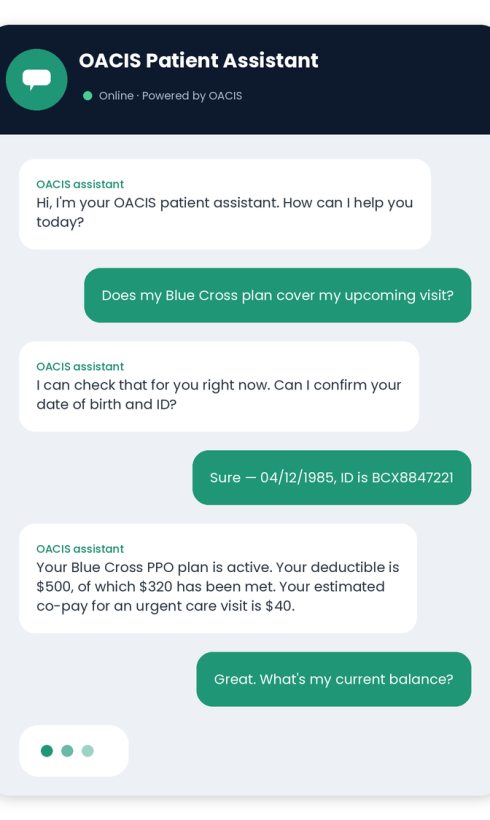
An always-on AI assistant that handles patient insurance queries, eligibility questions, balance inquiries, and appointment confirmations — freeing your front desk for complex interactions.
Most front office teams spend significant time answering routine patient questions: “What does my insurance cover?”, “What’s my balance?”, “Is my doctor in-network?” These questions are important, but they don’t require a trained staff member to answer.
The OACIS patient chatbot handles these inquiries 24/7, with seamless escalation to your OACIS Revenue Operations team when human intervention is needed — complete with full conversation context so nothing is repeated.
- Real-time insurance eligibility verification for patients
- Balance and co-pay inquiry handling
- Appointment confirmation and reminders
- Payment plan enrollment and online payments
- Claim status updates
- Seamless escalation with full context preserved

A free 30-minute Revenue Operations Review identifies exactly where collections are being delayed, denied, or lost — and what a realistic improvement looks like.
What happens after the patient visit
Revenue operations review
A free 30-minute assessment of your current revenue performance, leakage points, and improvement opportunity.
Revenue operations insights
Articles, research, and analysis on how AI and payer changes are reshaping revenue operations for independent practices.
Patterns we see again and again across independent practice revenue cycles.
The OACIS Healthcare team demonstrated a strong understanding of urgent care revenue cycle complexity and brought a level of operational insight that went far beyond traditional billing discussions. Their structured audit identified several revenue leakage patterns and meaningful operational and financial optimization opportunities that were not previously visible to our team.
We frequently begin audits at practices running denial rates near 20%, with no payer-specific workflow behind their billing. The denials are overwhelmingly preventable — eligibility gaps, missing authorizations, and modifier errors — and a disciplined, payer-specific process is what separates a sub-5% denial rate from a 20% one.
Claim rejections in the low double digits are common in practices without a structured front-end review. In our experience, the issue is almost never coding talent — it's the absence of a consistent guideline system. Once one is in place, rejections and denials typically fall sharply within the first two months.
A recurring red flag we document is A/R over 90 days sitting well above benchmark — often a quarter or more of total receivables — while net collection rates quietly underperform. Aging A/R is the clearest early signal that follow-up has no owner, and it's usually the fastest place to recover real dollars.
Out-of-network and non-par claims are where we see the most revenue left on the table. Without a deliberate strategy for timely filing and payer negotiation, low reimbursements get accepted as final and written-off balances go unrecovered — when many are, in fact, collectible with the right approach.